Two strength sessions a week are a practical place to start if you want to lift at home while eating keto. I would keep the first sessions deliberately plain: familiar movements, manageable weights and a few lines in a notebook. Leave recovery days between sessions, then use the log to decide what to do next time.
This is a general beginner template, not a programme tested in a keto trial or an individual prescription. If you want a gentler starting point without weights, use the existing short bodyweight routine.
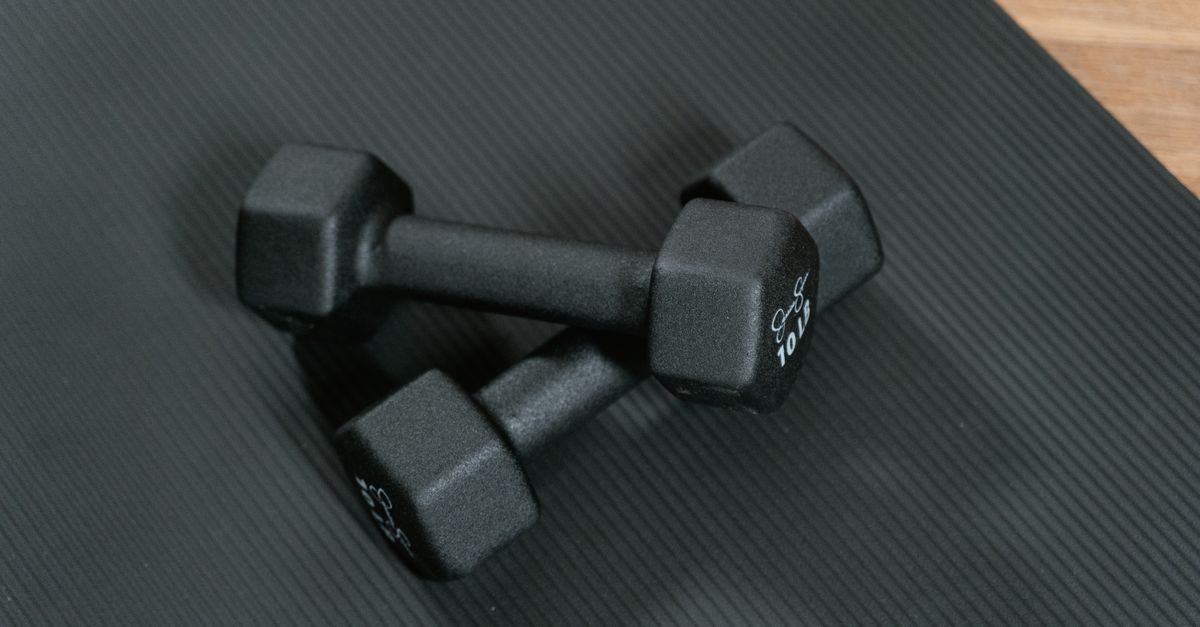
A pair of dumbbells and a clear space are enough to begin. The weights pictured are illustrative, not a suggested starting load. Photo: MART PRODUCTION / Pexels.
Why two days?
The American College of Sports Medicine’s 2026 guidance recommends training the major muscle groups at least twice weekly and building gradually. It also finds that complicated programmes and training every set to failure are not necessary for the average healthy adult. That supports a modest starting point, not a claim that two days are optimal for every goal.
Try Monday and Thursday, or any two days with at least a day between them. Repeat the same session on both days. Allow roughly 30 to 40 minutes once you know the movements, including rest. Walking or other comfortable activity can sit around it.
Set up before you start
You need dumbbells, floor space, and a solid support for the row. Adjustable weights are useful because your legs and back may need a different load from your pressing muscles. One fixed pair can become limiting; you do not need to force every exercise to use the same weight.
Start light enough to practise. Healthdirect’s beginner guidance stresses controlled technique, gradual increases and avoiding painful exercises. A qualified trainer can check unfamiliar movements before you load them.
Warm up with a few minutes of comfortable walking or marching, then practise each movement without weight or with a lighter weight. Clear the carry route and check that your row support cannot slide or tip.
The five-movement session
After the introductory week, aim for the following. A rep is one complete movement; a set is a group of reps before resting. Finish both sets of an exercise before moving on. Rest about one to two minutes between sets, longer if you need it to regain comfortable breathing and control.
| Movement | Starting target |
|---|---|
| Goblet squat | 2 sets of 8 to 12 reps |
| Dumbbell Romanian deadlift | 2 sets of 8 to 12 reps |
| Dumbbell floor press | 2 sets of 8 to 12 reps |
| Supported one-arm row | 2 sets of 8 to 12 reps on each side |
| Farmer carry | 2 carries of 20 to 30 seconds |
- Goblet squat: hold one dumbbell at your chest. Keep your feet planted and lower as far as you can control comfortably. Easier: sit down and stand up from a stable chair without a weight.
- Romanian deadlift: soften your knees, send your hips backwards and keep the weights close to your legs. Stop before your back starts rounding. Easier: practise the hip movement without weights.
- Floor press: lie on your back with knees bent. Lower until your upper arms gently meet the floor, then press up without bouncing. Easier: use lighter dumbbells or a wall press-up.
- One-arm row: support your free hand securely, pull the weight towards your hip and lower slowly without twisting. Easier: use a lighter weight and a shorter comfortable range.
- Farmer carry: walk slowly with weights beside you, shoulders relaxed and space clear. Easier: stand holding light weights, or shorten the carry.
For the repetition-based exercises, stop while you could still do roughly two or three more good reps. That is a practical effort guide, not a test you need to calculate perfectly. Stop a carry before your grip or posture gives way. Breathe throughout rather than deliberately holding your breath.
Make the first week a rehearsal
Do one set of each movement in your first two sessions. Learn how to put the weights down safely and how much support you need. If getting down to or up from the floor is difficult, get help choosing an alternative to the floor press.
Add the second set when the first is comfortable and you are recovering reasonably between sessions. Repeat the introductory week if needed. There is no deadline for earning heavier weights.
Add reps before you add weight
Keep the same load while you work within the 8-to-12-rep range. Add a repetition where you can do so with the same control and spare effort. The second set may have fewer reps than the first; record both rather than forcing a matching number.
When you can complete 12 controlled reps in both sets, with that spare effort, in two consecutive sessions, try the smallest comfortable weight increase. Start again towards the lower end of the range. If the new weight prevents eight controlled reps, or changes the movement, return to the previous load. A large fixed-weight jump is not an obligation.
After the one-set introductory stage, a hypothetical floor-press log might read as follows. The two numbers are the reps in set 1 and set 2.
| Two-set session | Log and next step |
|---|---|
| 1 | Your chosen manageable load: 10 / 9 reps. Keep the load. |
| 2 | Same load: 11 / 10 reps. Keep practising. |
| 3 | Same load: 12 / 12 reps. Repeat before increasing. |
| 4 | Same load: 12 / 12 reps, still controlled. Try a small increase next time. |
Progress is not expected every session. For rows, record each side; let the less capable side set the pace. For carries, extend a comfortable hold towards 30 seconds before considering more weight.
What changes because you eat keto?
The basic training principles do not change. Keto is not a requirement for getting stronger, and there is no reason to promise that it improves this routine.
In an eight-week randomised study of 21 experienced female lifters, the higher-carbohydrate group gained more squat and bench-press strength than the keto group. Energy intake also differed, so this small study does not isolate ketosis from every other dietary difference. Its supervised four-day programme was quite different from this beginner plan.
If you have just changed your diet, use the rehearsal stage rather than assuming a particular adaptation deadline. If performance repeatedly falls, look at food intake, recovery and whether strict carbohydrate restriction suits you. Do not automatically explain dizziness as “needing salt”, or turn a difficult session into a reason to fast harder.
Recovery and sensible limits
Eat regular meals with adequate protein and allow recovery between sessions. Our muscle-building explainer covers the wider diet questions; you do not need a supplement stack to use a training log.
If you take insulin or medicines that can cause low blood glucose, agree an exercise and food plan with your diabetes team. NIDDK explains that increased activity and insufficient carbohydrate can contribute to hypos. Treat one according to your care plan; preserving ketosis is not the priority.
Stop for pain, dizziness or feeling unwell. Persistent symptoms need assessment, not another set. After several weeks, review your log: more controlled reps, a manageable load increase or easier everyday tasks are more useful feedback than how sore you made yourself.
General information, not medical advice or individual coaching. Keto does not suit everyone; speak to a doctor or dietitian before changing your diet if pregnant, taking medication or managing a condition, and seek qualified exercise guidance for injuries or unfamiliar movements.